Pages

Showing posts with label garden events. Show all posts

Wednesday, August 26, 2015

Fall Garden Festival in Crossville

Jerry and I spent the day yesterday enjoying the Fall Garden Festival at the Plateau Experiment Station near Crossville, TN. In case you missed my presentation on fall vegetable gardening, I am posting the information from the handout I provided to festival attendees. You can email me with fall gardening questions, if you like.

Don’t Stop Now: Third Season Gardening in Tennessee
The approximate date of the first frost is October 20.
The approximate date of the first hard freeze is November 20.
You may have time for broccoli, Brussels sprouts or cauliflower if you can find good plants, or have already started seeds.
Think leafy greens and root crops for your main focus.
Fast maturity, frost tolerance, and overwintering capability are important considerations.
Pre-soak seeds to speed germination, especially carrots, parsley, beets and kale; direct sown seeds will germinate quickly in warm soil.
Some good choices and approximate maturity times are:


                arugula – 30-45 days
                bak choy – about 40 days
                beets – about 60 days, O
                carrots – about 60 days, O
                chard – about 60 days, O
                chervil – about 45 days, O
                cilantro – about 30 days, O
                cress – about 40 days
                kale – about 75 days, O
                lettuce – about 60 days
                mache – about 60 days
                mizuna – about 40 days
                mustard – about 40-60 days
                parsley – about 70 days, O
                scallions – about 60 days, O
                spinach—about 50 days
                tatsoi – about 45 days
                turnips – 30-45 days, O
O = often will overwinter in garden


Using season extending techniques can add up to a month of grow/harvest time.
Grow smaller plants in containers that can be moved indoors at night.
Use spaces where summer annuals grew for additional growing opportunities.
Covering a raised bed with plastic held up by PVC hoops has proven to be one of the cheapest, most effective methods for extending the season.
You can also build a temporary cold frame, using straw bales or concrete blocks and some old window sashes. (Check a window replacement company for these.)

Some Recommended Varieties

These recommendations are based on experience in our Zone 6b garden. All these vegetables can be direct seeded for fall harvest.

arugula – Speedy, Even’Star Winter, Roquette, “wild”
bak choy – Mei Quing
beets – Early Wonder, Detroit Dark Red, Early Wonder Tall Top
carrots – Atlas (containers), Little Finger, Danvers 126
chard – Lucullus, Neon Lights
chervil – Brussels Winter
cilantro – few named cultivars
cress – Belle Isle
kale – Dwarf Blue Curled, Lacinato, Red Russian, Vates
lettuce – Rougette de Montpelier, Tom Thumb, Ashley, Lollo Rossa, Rouge d’Hiver, Forrellenschluss,     Freckles, many others
mache – Salad Zing, Vit
mizuna – few named cultivars
mustard – Red Giant
parsley – Moss Curled, Italian
scallions – Evergreen White Bunching
spinach—Winter Bloomsdale
tatsoi –few named cultivars
turnips – Seven Top

                You can also plant transplants of these varieties. Garden centers typically have plants ready at the proper time for their location. These vegetables require about six weeks from seed to transplanting size, and so must be started in mid- to late-July for September transplanting. Once they resume growth, they are generally very cold tolerant.

broccoli—Di Cicco, Waltham 29
Brussels sprouts—Catskill
cabbage—Early Jersey Wakefield, Savoy Perfection
cauliflower—Snowball Self-Blanching (fall planted only)
kale—(see above)
kohlrabi—Early Purple Vienna
leek—King Sieg, Broad London, American Flag

Perennial onion bulbs are also planted in fall.

Monday, March 16, 2015

Out of Hibernation

After a month's hiatus due to family issues, I am back at the keyboard. We had an especially wintry February, but the current week has given us the first taste of 70-degree sunshine, and the vernal equinox is Thursday. The garden looks great, and we have lots of transplants waiting in the wings.

Yesterday we planted peas, transplanted spinach seedlings, and added compost to the bed where potatoes will be planted, on the traditional date, Tuesday, St. Patrick's Day. Appropriately enough, we are planting Irish Cobbler again this year. We will plant some radish seeds here and there, also. Cherry Belle is the variety we have chosen for spring planting. It produces roots about the size of a nickel.

Waiting in the wings are lettuce seedlings of several varieties, leeks about the diameter of a string, and a Greek basil, 'Bush Spicy Globe,' that we plan on keeping in containers.

We have been harvesting lettuce, parsley and cilantro from our windowsill garden, and will be replanting it with lettuce seedlings this week. As more and more crops become possible outdoors, we tend to focus on achieving "perfect" lettuce under the pampering conditions of our indoor garden.

I had the pleasure last Saturday of presenting a talk on spring vegetable gardening, as the guest of Stanley's Greenhouse.  Stanley's is also the sponsor of "Garden Talk," the radio show I co-host with Dr. Sue Hamilton and Andy Pulte. Please join us on Saturday mornings at 8:00 on 94.3 WNFZ-FM.

We have been forcing our Bletilla orchids for early blooms this season. You can find them at these local garden centers:

Stanley's Greenhouse
Ellenburg's Nursery and Landscaping
Mayo Garden Center, Emory Road
Mayo Garden Center, Bearden
Sweet Pea Garden and Gifts, Bearden

Please support your local, independent garden centers!


Sunday, February 15, 2015

Knox Home and Garden Show

We had the pleasure of attending the Knoxville Home and Garden Show on Saturday, courtesy of Stanley's Greenhouses, the sponsor of the "Garden Talk" radio broadcast. While we were blown away by the creative and beautiful exhibits presented by local landscapers and garden centers, more booths featured vendors of home improvement products than of garden products, based on my casual assessment. Now, this is not necessarily a bad thing. Merely a caution to those who might attend seeking the latest in herb plants or vegetable seeds. More likely, you can learn about hardscape, replacement windows, and outdoor kitchens.

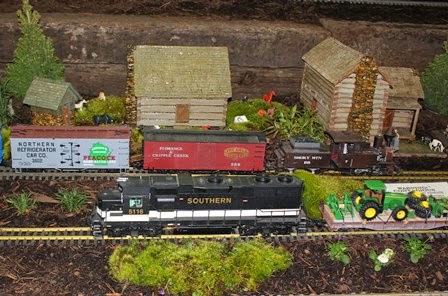
Two exhibits stood out in particular. The model railroad exhibit by Mark W. Fuhrman Complete Landscape Services, Inc., and the exhibit by Earthadelic, Inc., featuring dramatic lighting effects.

Fuhrman's model railroad is remarkably detailed, and depicts Smoky Mountain scenes with great accuracy. In the photo, a steam engine bearing the "Smoky Mountain RR" name passes a diesel engine from the Southern Railway System. The chimney on the mountain cabin in the background was created from river pebbles. The attention to details, right down to the Tremont Motel sign on a tiny replica building, is amazing.

Earthadelic, Inc. captured the beauty of a dormant coral bark maple (Acer palmatum cultivar) with uplighting using LEDs tuned to enhance the maple's outstanding winter coloration. Paired with forced tulips and blue hydrangeas, the effect was dramatic, as you can see from the image.

One highlight of the show, alone worth the reasonable price of admission, is the exhibit of fine woodworking from the Appalachian Center for Craft at Smithville. Both furniture and art works are on display, with several of the master cabinetmakers on hand to talk about their work. We saw some truly fine examples of inlaid decoration, and both modern and classical furniture, flawlessly executed in woods ranging from exotic ebony and zebra-wood to regional hickory, sugar maple and oak. Only some of the pieces are for sale.

The show runs through today, and is a fundraiser for the Dogwood Arts Festival. Take the family, and enjoy a taste of spring, as you wander through the exhibits featuring forced blooms and fresh green leaves. A good way to prepare yourself for the snowy cold coming this week.

Saturday, May 10, 2014

Time to Plant Tomatoes

Mother's Day is the traditional time to plant tomatoes in East Tennessee. Another way to determine the correct planting time: the dogwoods should have dropped their blossoms and be fully leafed-out. These are convenient ways to remember that tomatoes should be transplanted after the soil temperature is above 65 degrees.

I know, I know, many people plant tomatoes in April in hopes of an early harvest. They use all sorts of season extenders in hope of having ripe fruits before anyone else in the neighborhood. Nevertheless, despite all the effort and expense, these tomatoes ripen around July 4, just like everyone else's. The most effective way to get a jump on the season is black plastic mulch, applied around the base of the plant at transplant time. This will help increase the soil temperature. But it is unlikely to shorten the time to maturity by much more than a week.

Assuming you are planting some tomato plants this weekend or next week, here are a couple of tips for a bigger harvest:

1) Plant deeply. Remove all but the top three clusters of leaves and bury the stem deeply enough that the lowermost leaf cluster is about an inch above the soil line. This encourages development of a large root system to support the eventual crop.

2) Remove blooms. Pinch off all blooms that are present on your transplants. These will sap energy, and although they may produce some early fruits, the overall harvest will be reduced.

3) Feed early. Put a couple of tablespoons of balanced organic fertilizer in the planting hole. As growth resumes about a week after transplanting, you can also side-dress the plants with another round of food. Feed about every two weeks until blooms appear, then stop feeding. Too much nitrogen after blooming begins will reduce the crop.

4) Mulch immediately. Apply two or more inches of mulch as soon as your plants are in the ground. Mulch not only helps maintain even soil moisture, important for tomatoes, but also prevents soil splashing up on the leaves during a rain. Soil can carry the spore of disease organisms such as Fusarium and Verticillium.

5) Grow hybrids. If you are an inexperienced gardener, grow modern, disease resistant hybrids and buy your heirloom tomatoes at the Farmer's Market. Heirlooms are delicious, but many of them have no resistance to common diseases, and can be a challenge to grow in our hot, humid climate.

Also, if you use tobacco, wash your hands thoroughly before going into the tomato patch, and don't use tobacco in the garden area. Tobacco can transmit TMV (tobacco mosaic virus) to your tomatoes.

I will be giving a presentation this afternoon at 2:00 at UT Gardens, as part of the annual Bloomsdays event. Stop by the South Greenhouse, say hello, and catch my talk on growing hardy orchids in the Tennessee Valley. The event is open today and tomorrow from 9:00Am to 5:00PM. I hope to see you there!


Saturday, July 13, 2013

Too Much of a Good Thing

Rain, rain, go away. Come again another day.

We are way above normal on rainfall in the Tennessee Valley. The wet and cloudy weather has begun to take its toll on vegetable gardens. While most veggies need an inch of water each week to thrive, we have been averaging about four times that amount. The extra moisture, coupled with long periods with no sunshine, has created ideal conditions for fungi to attack our crops.

Cucumbers sometimes develop a black, fuzzy mold under these conditions. Pick of and destroy deformed or damaged fruits as soon as you find them. This will help curb spore production by the fungus. Keeping the fruits picked also keeps the plants blooming. Hopefully, as the weather improves the cukes will still be producing.

Summer squash may be showing signs of powdery mildew  on the leaves, and immature fruits may also develop mold growth.

Some varieties of tomatoes are showing signs of early blight. Brown spots form on the leaves before the leaves turn yellow and fall off the plant.

In all of these cases, there are some steps you can take to preserve at least some of your crop. Increase air circulation around plants by thinning leaves or even entire plants. Remove and destroy plant parts showing signs of fungal attack. Do not compost this material. Burn it or place it in the trash. Avoid watering (duh!) and fertilization when plants are stressed by too much moisture. Spray infected foliage with neem oil. This has proven effective for me with both powdery mildew and blight attacks. As a rule, plants growing in raised beds will fare better than in-ground plantings.

The abundant water will also encourage a bumper crop when the plants get enough sun. Green beans, cucumbers and squash are all producing heavily in many gardens. Tomatoes are coming along, with early ones appearing in all the local markets, even though the real tomato season is the month of August.

Fall Vegetable Talk July 14
Please join me Sunday, July 14, at 2:00 PM at UT Gardens on Neyland Drive for a presentation and discussion on fall vegetable gardening in the Tennessee Valley. I will be offering advice on what to plant and when, to take advantage of our fall--and winter!--growing seasons.

Saturday, May 18, 2013

The Busy Time of Year

If you're not busy this week, you're not gardening! I've been working around the rain showers all week. We transplanted tomato and parsley plants, and planted cucumbers, corn and beans. We have a second round of tomatoes and our pepper crop to pot up to four inch pots from the cell trays in which they germinated about three weeks ago. And it is time to start more basil and parsley seeds for transplanting in late June or early July.

I find it is hard to have too much of either parsley or basil during the summer months. For one thing, both go great with tomatoes and cucumbers, the king and queen of the summer veggie garden. Parsley is also a preferred host plant for the black swallowtail butterfly. Hardly had I put my four new plants into the garden when they were visited by a female black swallowtail, deftly placing individual eggs here and there on my plants. I don't mind, as the colorful green, yellow and black striped caterpillars don't usually kill the plants. After the caterpillars are done, the parsley usually bounces back and provides plenty of leaves for the table. I do try to give them a little cottonseed meal or other nitrogen source, to help things along.

The relationship of parsley and parsley worm involves more than eating and being eaten. The chemicals that give parsley (and other members of the celery family) its distinctive flavor provide the caterpillar with raw materials for an interesting defense against its predators. When disturbed, the caterpillar rears up and exposes a specialized scent gland, the osmetarium, releasing an unusual odor, faintly reminiscent of...parsley. The osmetarium looks like a pair of antlers, yellow orange in color. Besides parsley, the caterpillar feeds on carrots, dill, celery and golden alexanders. You may see the caterpillar on Queen Anne's lace, which is a feral carrot.

The corn variety we selected this year is Ambrosia. It is a bi-color, sugar enhanced hybrid cord that bears early. In other words, purely the creation of plant breeders. Modern hybrid sweet corn, however, is not only easier to grow than older types, it is much more forgiving to the novice gardener who may not be sure when to pick. With, for example, Silver Queen, the window of perfection may only be a couple of days. With Ambrosia, you can be off by a week and still have an acceptable quality ear. Corn takes a lot of room and a lot of nitrogen, and you can buy it for $5 a dozen at the farmer's market. But there is nothing like truly fresh sweet corn for summer flavor.

We are growing an old standard cucumber, Boston Pickling. I intend to convert at least six pounds of our crop into a batch of my grandmother's sweet pickles. Last year was a lousy season for cucumbers. We are hoping for better results this year.

We planted Bush Romano and Goldrush beans. The former are long, flat Italian-type beans that are loaded with flavor and can stand up to long cooking. The latter are yellow wax beans that are perfect for summer salads after a brief blanching. Beans can be planted every two weeks from now until the middle of July, for a continuous harvest. Later plantings are more subject to bean beetles than are earlier ones.

UT Gardens Farmer's Market Now Open
Last Wednesday, May 15, I had the pleasure of staffing a question-and-answer table at the UT Gardens Farmer's Market. Thanks to the efforts of market director Becca Mattingly and a great group of local farmers and craftspeople, the kickoff was a huge success. The market is open every Wednesday from 4:00-7:00 PM at UT Gardens off Neyland Drive. Parking is free, there is music and food, a tent-full of activities for the kids, and the area is pet friendly. You can tour the gardens, grab a Vietnamese spring roll or a Tennessee fried pie and shop for dinner all in one place. I tried the Thai-style iced tea and loved it. Wildflower honey and organic beauty aids all await your perusal from Honey Dew Naturals of Strawberry Plains. Baked goods from great local vendors like Hillside Bakery and VJ's complement all the fresh produce and cut flowers on display by multiple growers. I or another person will be there to answer your gardening questions every week, so please drop by and say hello.

Saturday, May 4, 2013

New Radio Frequency and More

Beginning with this morning's broadcast, "Garden Talk" has a new radio frequency. We are on 850 AM, WKVL, "The Voice of Knoxville," at 8:00 AM every Saturday to take your calls. My co-hosts are Andy Pulte (The Garden Guy) and Dr. Sue Hamilton, Director of UT Gardens.

Our Plant of the Week this week is Chinese Hardy Ground Orchid, Bletilla striata. This is an under-appreciated plant in the Tennessee Valley region, but it blooms and grows as reliably as daffodils. Unlike their tropical cousins, these orchids from temperate Asia are hardy as far north as Zone 5. Magenta blooms have an interesting ruffled lip and a light fragrance reminiscent of hyacinths.

Contact me for information on where to obtain plants.


Set container-grown plants in full sun to partial shade in any well-drained garden soil suitable for perennial flowers. Amend heavy clay soil with organic matter to improve aeration and retain moisture. They grow very well in containers, also.
Plants should receive irrigation if rainfall is insufficient, up until the time the blooms fade. After blooming, they can get along with less water. Plants in full sun may develop brown leaf tips if water stressed during the hottest part of summer. This does not appear to harm them.
Feed a balanced, all-purpose fertilizer once a season, in spring as the leaves unfurl. Plants grown in containers should be fertilized with a liquid product monthly.
When foliage dies back and the ground is cold, usually after Thanksgiving, mulch the plants with three or four inches of autumn leaves or pine needles. This is not absolutely necessary, but it helps to prevent early spring emergence. New growth that appears too early can be damaged by a late frost, making the leaves less attractive. The plants usually recover and bloom normally.

Still Time for Cool Season Veggies

You still have time to plant carrots, scallions and radishes for early summer harvest. Leafy greens, especially heat tolerant ones like Romaine lettuce, can also be planted now.

We have likely had our last frost of the year, although we are not completely out of the woods. We have had frost in May, but only rarely. Go ahead and transplant tomatoes, but wait another couple of weeks before transplanting peppers, cucumbers or other heat-loving crops.

Hosta Society Sale

The local Hosta Society is having their annual sale tomorrow, May 5, in the UT Gardens parking lot from noon until 4 PM. Find many varieties of hosta, as well as ferns and other shade lovers, on sale from members. Rain or shine.

Friday, April 12, 2013

On the Road


We have just arrived in Abingdon, Virginia for the 16th Annual Mid-Atlantic Garden Faire this weekend at the Southwest Virginia Higher Education Center. I will be giving two presentations tomorrow.
 
From 11:45 until 1:00 I will be speaking on topics drawn from The New American Homestead, and helping audience members to discover how they can produce more food from home. The presentation will highlight how gardeners can find the space, sunshine, and time they need for food gardening.

From 2:00 until 3:15 I will be speaking on Pay Dirt: How to Make $10,000 a Year From Your Backyard Garden. Whether you raise produce for a restaurant, or nursery stock for a garden center, growing your own home-based business is easier than you think.

Both presentations will be taking place in the Executive Auditorium. Ample time will be available to answer questions from the audience.

The Garden Faire is sponsored by the Master Gardeners of Southwest Virginia, and features design competitions, a nature photography exhibit, a tour of rain gardens in the Abingdon area, exhibits from the American Chestnut Foundation and other non-profit groups, and a Garden Marketplace with many area vendors. Master Gardeners will be on hand to answer questions, too.

It is not too late to head up to Abingdon for tomorrow's events.

The Southwest Virginia Higher Education Center is located just off Interstate 81 at Exit 14.
See you there!